Scholarships in USA for Bangladeshi Students
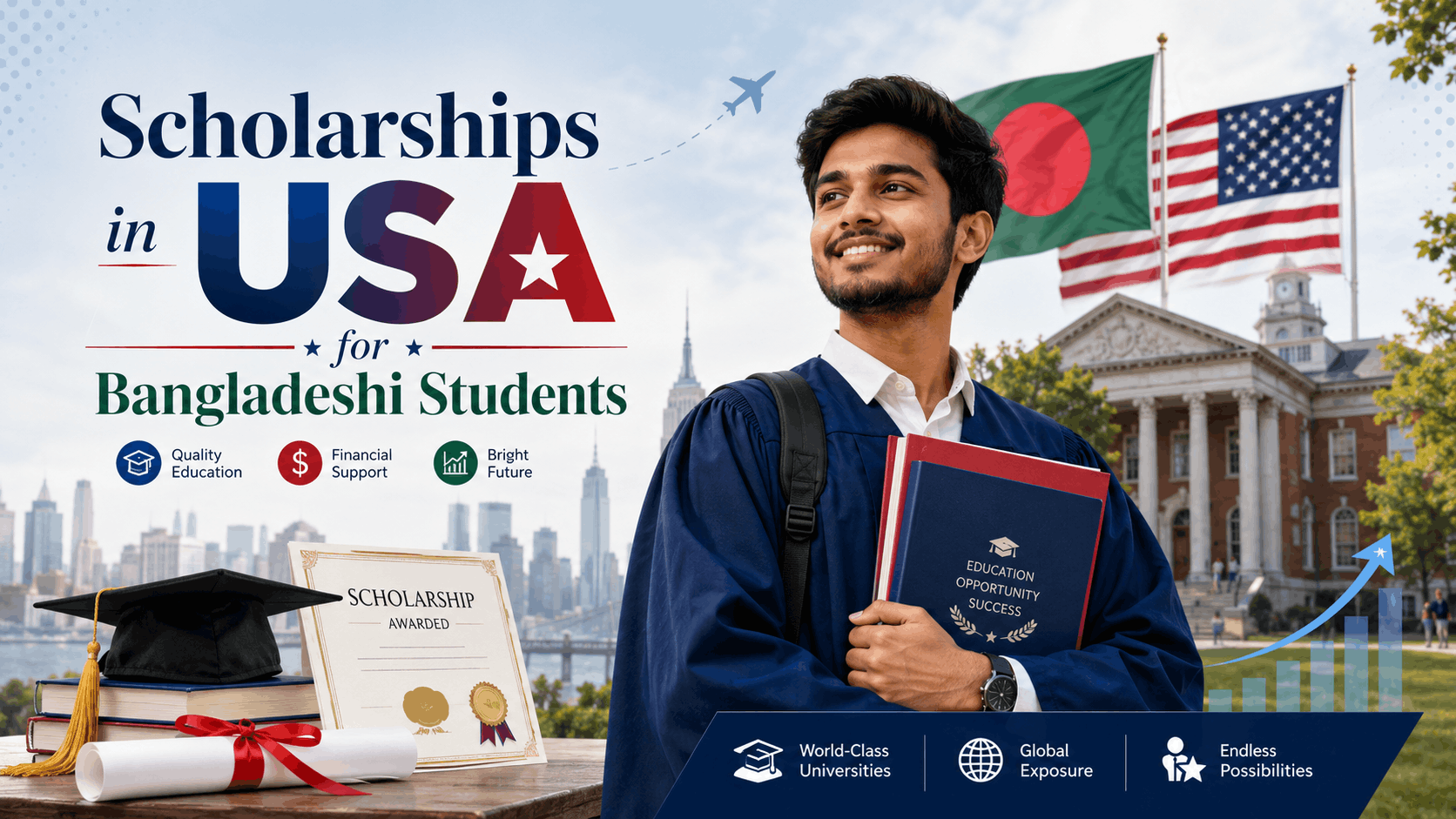
Studying in the United States can provide Bangladeshi students with access to globally recognised universities, advanced research facilities, flexible academic programs and strong career-development opportunities. However, tuition fees and living expenses in the USA can be extremely high.
Scholarships, university grants, fellowships and graduate assistantships can reduce these costs significantly. In some cases, a funding package may cover tuition fees, accommodation, health insurance, travel and living expenses. However, fully funded opportunities are highly competitive, and students should not assume that every scholarship will cover the complete cost of studying in the United States.
International students receive financial assistance from many U.S. institutions, but competition is intense. EducationUSA recommends beginning financial planning early and applying for financial aid alongside the university admission application. (EducationUSA)
This guide explains the main scholarship opportunities, eligibility requirements, required documents, application process and practical strategies for Bangladeshi students who want to study in the USA.
USA Scholarships for Bangladeshi Students at a Glance
| Funding option | Suitable for | Possible coverage | Separate application |
|---|---|---|---|
| University merit scholarship | Undergraduate and graduate students | Partial to full tuition | Sometimes |
| University need-based aid | Mainly undergraduate students | Tuition, housing, meals and other costs | Usually required |
| Fulbright Foreign Student Program | Master’s students and researchers | Major academic and living expenses | Yes |
| Hubert H. Humphrey Fellowship | Experienced professionals | Program costs and living support | Yes |
| Graduate assistantship | Master’s and PhD students | Tuition waiver and stipend | Usually |
| Departmental fellowship | Graduate and doctoral students | Partial or full funding | Varies |
| Private scholarship | Different academic levels | Small award to full funding | Yes |
| Short-term exchange program | Students, educators or professionals | Travel and program expenses | Yes |
What Does “Fully Funded Scholarship” Actually Mean?
The phrase “fully funded scholarship” is frequently misused. A scholarship should not be considered fully funded simply because it covers tuition fees.
A genuinely comprehensive funding package may include:
- Full tuition and mandatory university fees
- Accommodation or a housing allowance
- Monthly living stipend
- Health insurance
- Books and academic materials
- Round-trip airfare
- Visa-related or settling-in allowances
- Research or conference funding
Some awards cover only tuition. Others provide a fixed annual amount that may still leave the student responsible for housing, food, insurance and transportation.
Before accepting any scholarship, calculate the remaining amount that you or your family must pay. Read the award letter carefully instead of relying on promotional phrases such as “up to full tuition.”
Main Types of Scholarships in the USA
1. Merit-Based Scholarships
Merit scholarships are awarded to students with strong academic records, test scores, leadership experience, extracurricular involvement, research achievements or other exceptional abilities.
Universities may consider:
- SSC, HSC, O-Level or A-Level results
- Undergraduate CGPA
- Academic improvement over time
- SAT, ACT, GRE or GMAT scores where required
- Olympiad, competition or research achievements
- Leadership and community service
- Creative, athletic or entrepreneurial accomplishments
Some universities automatically consider admitted students for merit scholarships. Others require a separate scholarship application, additional essays or an earlier admission deadline.
Merit awards may cover a small portion of tuition, half tuition or, in rare cases, the full cost of attendance.
2. Need-Based Financial Aid
Need-based aid is determined by the financial circumstances of the student and their family. It is different from a merit scholarship because the amount is based mainly on demonstrated financial need.
Several U.S. universities offer institutional need-based aid to international students. Some require the CSS Profile, family income documents, bank statements, tax records or employer certificates. The CSS Profile allows international families to report income, assets and expenses in their local currency. (CSS Profile)
A small number of highly selective universities provide exceptionally generous aid to admitted international undergraduate students. For example, MIT says it meets 100% of demonstrated financial need for international undergraduates, while Yale states that international applicants are eligible for the same need-based financial aid system as domestic applicants. (MIT Student Financial Services)
These policies sound attractive, but admission to such institutions is extraordinarily competitive. Financial need does not compensate for a weak academic or extracurricular profile.
3. University-Specific Scholarships
Many universities offer scholarships exclusively to their own applicants. These may be called:
- International Student Scholarship
- Presidential Scholarship
- Dean’s Scholarship
- Global Excellence Award
- Trustee Scholarship
- International Merit Award
- Academic Achievement Scholarship
- Diversity or Leadership Scholarship
The scholarship amount and selection process differ significantly between institutions. Some awards are renewable for four years, while others are provided only for the first year.
Students should check:
- Whether international students are eligible
- Whether the award is automatic or competitive
- The minimum credit requirement
- The CGPA required for renewal
- Whether the scholarship covers tuition only
- Whether housing, insurance and fees remain unpaid
- Whether the student must submit an application before the regular admission deadline
EducationUSA maintains a financial-aid search resource containing scholarships and special opportunities offered by U.S. institutions to international students. (EducationUSA)
4. Government-Funded Scholarships and Exchange Programs
Government-sponsored programs are among the most competitive opportunities available to Bangladeshi applicants. These programs may focus on academic study, leadership development, research or professional exchange.
Fulbright Foreign Student Program
The Fulbright Foreign Student Program supports eligible graduate students, young professionals and artists from outside the United States who want to study or conduct research in the USA.
The program operates in more than 160 countries and supports approximately 4,000 foreign students globally each year. Application procedures, eligible fields, placement arrangements and funding benefits vary by country. Bangladeshi applicants must follow the instructions published for Bangladesh by the U.S. Embassy or the relevant Fulbright office. (Fulbright Foreign Program)
Depending on the country-specific award, support may include:
- Tuition and university fees
- Monthly maintenance allowance
- Health coverage
- Airfare
- Academic materials
- Pre-academic preparation
- Visa sponsorship and program support
Applicants typically need a strong academic background, clear study objectives, leadership potential and a convincing explanation of how their education will benefit Bangladesh.
Hubert H. Humphrey Fellowship Program
The Hubert H. Humphrey Fellowship is designed for experienced, mid-career professionals. It is not a regular bachelor’s, master’s or PhD scholarship. Fellows participate in a non-degree academic and professional-development program in the United States.
Applicants are generally expected to demonstrate:
- Relevant professional experience
- Leadership ability
- Commitment to public service
- Potential to contribute to their professional field
- A strong reason for pursuing the fellowship
- Intention to apply the experience after returning to Bangladesh
The usual Bangladesh application period has historically fallen between April and June, although dates can change each year. Applicants must use the latest U.S. Embassy Bangladesh announcement rather than relying on an old deadline. (U.S. Embassy in Bangladesh)
Study of the U.S. Institutes
Study of the U.S. Institutes, commonly known as SUSI, includes short-term academic exchange programs for selected groups such as undergraduate student leaders, educators and scholars.
The student-leader programs generally involve several weeks of academic study and educational activities. They are valuable exchange opportunities but should not be presented as full undergraduate degree scholarships. (U.S. Embassy in Bangladesh)
Eligibility depends on the specific SUSI category announced for Bangladesh.
5. Graduate Assistantships
Graduate assistantships are among the most practical funding routes for Bangladeshi students applying for research-based master’s and PhD programs.
The main categories are:
Research Assistantship
A research assistant works with a professor, laboratory or research group. Responsibilities may include:
- Conducting experiments
- Collecting and analysing data
- Reviewing academic literature
- Developing software or technical models
- Preparing research reports
- Supporting journal or conference publications
Teaching Assistantship
A teaching assistant may:
- Lead laboratory or discussion sessions
- Grade assignments
- Help students during office hours
- Support course administration
- Teach introductory classes
- Assist faculty members with course materials
- Graduate Assistantship
A general graduate assistant may work in an academic department, research centre, student office or university administration.
Assistantship packages may provide:
- Full or partial tuition waiver
- Monthly or biweekly stipend
- Health-insurance contribution
- Reduced university fees
However, funding is not guaranteed simply because a student is admitted. Some departments fund most PhD students but provide limited support to master’s students. Students must read the department’s funding policy carefully.
6. Fellowships and Departmental Funding
Graduate schools and academic departments may offer fellowships based on academic excellence, research potential, diversity, professional experience or alignment with a funded project.
Unlike assistantships, some fellowships do not require regular teaching or research work. Others include specific academic responsibilities.
Potential sources include:
- University graduate schools
- Academic departments
- Research institutes
- Faculty research grants
- Professional associations
- Foundations and nonprofit organisations
- Industry-sponsored research projects
Students pursuing a PhD should prioritise programs that clearly explain their funding guarantee, stipend duration, summer support, health insurance and teaching obligations.
7. Private and External Scholarships
Private organisations, charitable foundations, professional associations and international organisations sometimes provide funding for international students.
These awards may target:
- Women in specific fields
- Students from developing countries
- Public-health professionals
- Engineers or technology students
- Environmental researchers
- Journalists
- Human-rights professionals
- Students demonstrating financial hardship
- Applicants with strong community leadership
External scholarships are useful, but many provide only a small amount compared with total U.S. education costs. Students should treat them as supplementary funding unless the award clearly covers the full cost of attendance.
Eligibility Requirements
There is no universal eligibility rule for every U.S. scholarship. Claims that all applicants need a 3.5 GPA, IELTS 7.0 or a particular age are inaccurate.
Requirements vary according to the university, degree level and funding organisation.
Academic Qualifications
Applicants must normally satisfy the admission requirements of their chosen degree.
For undergraduate admission, universities may review:
- SSC and HSC results
- O-Level and A-Level results
- Academic subjects completed
- School rank where available
- Predicted grades
- SAT or ACT scores where required
- Academic competitions and achievements
For graduate admission, universities may consider:
- Bachelor’s or master’s CGPA
- Relevant coursework
- Research experience
- Publications
- Thesis or project work
- GRE or GMAT results where required
- Professional qualifications
- Work experience
A lower CGPA does not automatically make scholarship admission impossible, but it must usually be offset by substantial strengths elsewhere.
English-Language Proficiency
Universities may accept one or more of the following:
- IELTS Academic
- TOEFL iBT
- Duolingo English Test
- Cambridge English qualifications
- PTE Academic
Some institutions waive the English test if the applicant completed previous education in English. Others do not.
There is no single IELTS score that guarantees scholarship eligibility. Applicants must check both the university’s admission requirement and the scholarship’s separate requirement.
Leadership and Extracurricular Activities
Competitive scholarships often look beyond grades. Evidence of leadership may include:
- Managing a student organisation
- Leading a community project
- Volunteering consistently
- Founding a social initiative
- Organising educational activities
- Mentoring younger students
- Participating in debate, sports or cultural organisations
- Solving a measurable local problem
Listing random club memberships is not enough. Selection committees are more interested in what the applicant actually achieved.
Research or Professional Experience
Research-based graduate programs may expect:
- Undergraduate thesis work
- Research assistant experience
- Conference presentations
- Journal publications
- Laboratory or field experience
- Statistical or technical skills
- A clear research proposal
Professional fellowships may require several years of full-time work and evidence that the applicant has assumed meaningful responsibility.
Citizenship and Residency
Bangladesh-specific government or exchange programs generally require Bangladeshi citizenship and may require the applicant to reside in Bangladesh during the application process.
University scholarships available to all international students may not impose a Bangladesh residency requirement.
Required Documents
Students should prepare their documents several months before the deadline.
Common Admission and Scholarship Documents
- Completed online application
- Valid passport
- Academic transcripts and certificates
- Certified English translations where necessary
- English-proficiency test score
- SAT, ACT, GRE or GMAT score when required
- Statement of Purpose or personal essay
- Letters of recommendation
- Updated CV or résumé
- Research proposal for certain graduate programs
- Writing sample or portfolio where required
- Evidence of extracurricular and leadership activities
- Work-experience certificates
- Financial-aid forms
- Family income and asset documents
- Bank statements or sponsorship documents
- Scholarship-specific essays
Never submit altered bank statements, fake employment certificates or exaggerated extracurricular records. Universities can cancel admission and funding if application fraud is discovered.
How to Write a Strong Statement of Purpose
A strong Statement of Purpose should explain:
- What you want to study
- Why you selected the subject
- How your previous education prepared you
- What academic or professional problems interest you
- Why the selected university is appropriate
- How specific courses, professors or research facilities fit your goals
- What you plan to do after graduation
- How the education will create practical impact
Avoid generic sentences about the USA being a developed country or the university being world-famous. Those statements reveal no serious research.
A credible SOP connects the applicant’s past experience, proposed degree and future plan into one logical story.
How to Obtain Strong Recommendation Letters
A useful recommendation letter should come from someone who knows the applicant’s academic or professional work well.
Suitable recommenders may include:
- University professors
- Thesis supervisors
- Research mentors
- Department heads
- Employers
- Project supervisors
A famous person who barely knows the applicant is usually a poor recommender.
Provide the recommender with:
- Your updated CV
- Academic transcript
- Draft Statement of Purpose
- Scholarship information
- Submission deadline
- Examples of work completed under their supervision
Give recommenders several weeks rather than asking them one day before the deadline.
Step-by-Step Application Process
Step 1: Decide Your Degree and Academic Goal
Identify whether you are applying for:
- Bachelor’s degree
- Master’s degree
- PhD
- Non-degree fellowship
- Short-term exchange program
Do not apply randomly across unrelated subjects. A confused academic plan weakens both admission and scholarship applications.
Step 2: Calculate Your Real Budget
Estimate:
- Tuition
- Mandatory fees
- Accommodation
- Food
- Health insurance
- Books and supplies
- Local transportation
- Airfare
- Visa and SEVIS costs
- Personal expenses
Then determine how much funding you actually need.
Most foreign citizens are not eligible for U.S. federal student aid, so Bangladeshi students normally depend on university funding, scholarships, assistantships, personal funds or private sponsorship.
Step 3: Build a Balanced University List
Divide universities into three practical groups:
- Highly competitive universities with generous funding
- Universities where your academic profile is competitive
- Financially safer options offering predictable merit awards or lower total costs
Applying only to Ivy League or top-ranked universities is not a strategy. It is gambling.
Look at funding and total cost, not only ranking.
Step 4: Check Scholarship Conditions
For every university, record:
- Admission deadline
- Scholarship deadline
- Financial-aid deadline
- Separate application requirement
- Test requirements
- Scholarship amount
- Renewal conditions
- Expected family contribution
- Remaining annual cost
A spreadsheet is useful for tracking this information.
Step 5: Take Required Tests Early
Take English-language and standardised tests early enough to retake them when necessary.
Do not assume every university is test-optional. Testing policies change, and scholarship consideration may have different rules from general admission.
Step 6: Prepare Essays and Documents
Prepare the main personal statement first, but customise it for each program.
Scholarship committees can easily recognise essays that were written for a different university and submitted without proper editing.
Step 7: Contact Graduate Departments or Professors
This step is mainly relevant to research-focused master’s and PhD applicants.
Before contacting a professor:
- Read the professor’s recent research
- Confirm that the professor is accepting students
- Explain your relevant experience
- Identify a specific research connection
- Keep the email concise
- Attach a professional CV
Do not send generic mass emails beginning with “Dear Respected Sir” and asking for a fully funded scholarship without discussing research.
Step 8: Submit Admission and Aid Applications
A university admission application and a financial-aid application may be separate.
Submitting one does not always complete the other.
Some universities use the CSS Profile for institutional aid. Others use their own financial forms or accept alternative documentation. College Board advises applicants to verify which institutions require the CSS Profile and follow each institution’s deadline. (CSS Profile)
Step 9: Compare Funding Offers
Do not compare awards only by scholarship amount.
A USD 25,000 scholarship at an expensive university may leave a larger financial gap than a USD 15,000 scholarship at a lower-cost institution.
Compare the final net cost:
Total cost of attendance – grants and scholarships = amount you must pay
Loans and student employment should not automatically be treated as scholarship money.
Step 10: Complete the Visa Process
After admission and financial documentation are approved, the university may issue the required immigration document for the student-visa process.
The F-1 visa is the common category for full-time international students pursuing academic study, while the M-1 category is generally used for vocational study. (USAGov)
A scholarship does not guarantee visa approval. Applicants must still satisfy the visa requirements and demonstrate that their overall study plan is credible.
Recommended Application Timeline
18–24 Months Before Enrolment
- Research degree options
- Review funding possibilities
- Improve academic and extracurricular profile
- Gain research or professional experience
- Prepare for English and standardised tests
12–18 Months Before Enrolment
- Finalise university list
- Take required tests
- Contact potential graduate supervisors
- Request recommendation letters
- Begin writing essays
- Prepare financial documents
8–12 Months Before Enrolment
- Submit early admission applications
- Complete scholarship forms
- Submit CSS Profile or institutional aid forms
- Verify that recommendation letters and test scores arrived
4–8 Months Before Enrolment
- Review decisions
- Compare financial-aid packages
- Provide additional financial documents
- Accept the best affordable offer
- Begin visa preparation
1–4 Months Before Enrolment
- Attend visa interview
- Arrange accommodation
- Purchase health insurance where necessary
- Prepare travel and academic documents
- Attend pre-departure orientation
Exact deadlines vary. Applicants must use current official pages rather than copying dates from blogs or previous admission cycles.
Scholarship Strategy for Undergraduate Students
Fully funded undergraduate opportunities are rare and brutally competitive.
A strong undergraduate strategy should include:
- Universities offering substantial merit scholarships
- Institutions providing need-based aid to international students
- Universities with lower tuition and living costs
- Liberal-arts colleges with strong institutional aid
- Schools where your academic results are well above the typical admitted-student range
For need-based aid, families should prepare accurate records of:
- Annual income
- Property and assets
- Savings
- Business income
- Household expenses
- Number of dependants
- Educational expenses of siblings
- Exceptional medical or family costs
Never assume that declaring zero ability to pay will improve your chances. At need-aware institutions, requiring very large financial aid can make admission more difficult.
Scholarship Strategy for Master’s Students
Master’s funding is inconsistent.
Some programs offer:
- Merit scholarships
- Tuition discounts
- Research assistantships
- Teaching assistantships
- Departmental fellowships
- Hourly campus employment
Professional master’s programs in fields such as business, analytics or engineering may provide only limited funding. Research-based programs may offer better assistantship opportunities, but this depends on the department.
Applicants should ask:
- Are master’s students eligible for assistantships?
- What percentage of students receive funding?
- Is funding guaranteed or competitive after enrolment?
- Does the stipend cover living expenses?
- Are tuition and fees fully waived?
- Is summer funding available?
Scholarship Strategy for PhD Students
In many academic fields, strong U.S. PhD programs provide admitted students with multi-year funding.
A typical package may include:
- Tuition remission
- Living stipend
- Health-insurance support
- Research or teaching responsibilities
- Funding for a fixed number of years
However, students must verify:
- Guaranteed funding duration
- Minimum academic-progress requirements
- Teaching workload
- Summer support
- Mandatory student fees
- Health-insurance costs
- Funding after the guaranteed period
Paying the full cost of a research PhD in the USA is usually a poor financial decision, especially when funded alternatives exist.
How to Improve Your Scholarship Chances
Maintain Strong Academic Performance
Grades matter, particularly for competitive merit scholarships. However, scholarship selection is rarely based on CGPA alone.
Develop a Coherent Profile
Your subject, activities, research and future goals should make sense together.
Ten unrelated certificates are less valuable than sustained work in one meaningful area.
Demonstrate Measurable Impact
Instead of writing that you “helped the community,” explain:
- What problem you addressed
- How many people participated
- What you personally did
- What changed as a result
- How the project continued
Apply to the Right Universities
A student with average credentials should not expect a full scholarship from the most selective universities merely because financial need is high.
Target institutions where your achievements are competitive.
Start Early
Scholarship applications require research, testing, essays, recommendations and financial paperwork. Rushing creates weak essays and preventable errors.
Follow Every Instruction
An excellent applicant can still be rejected for:
- Missing a document
- Ignoring the word limit
- Submitting after the deadline
- Choosing an ineligible program
- Failing to complete the financial-aid form
- Providing inconsistent information
Apply Broadly but Selectively
More applications can improve your chances only when each application is suitable and properly prepared.
Submitting 30 weak, generic applications is not better than submitting 10 strong and targeted applications.
Common Scholarship Application Mistakes
Believing There Is One Universal GPA Requirement
There is no standard GPA requirement for every scholarship. Some programs publish a minimum, while others use holistic evaluation.
Assuming IELTS Is Always Mandatory
IELTS is widely accepted, but universities may accept other tests or grant waivers.
Confusing Admission With Funding
An admission offer may contain no scholarship. Read the financial section separately.
Ignoring the Remaining Cost
A partial scholarship may still leave an unaffordable balance.
Using the Same Essay Everywhere
Generic essays usually fail to explain why the applicant fits a particular program.
Submitting Weak Recommendation Letters
A vague letter saying the student is “hardworking and sincere” adds little value.
Contacting Professors With Generic Emails
Mass emails damage credibility and are usually ignored.
Using Scholarship Agents Who Guarantee Funding
No legitimate consultant can guarantee admission, scholarship or visa approval. Claims of guaranteed full funding should be treated as a warning sign.
Depending on Part-Time Work to Pay Tuition
International-student employment is regulated. F-1 students may generally work on campus under specified conditions, commonly up to 20 hours per week while school is in session. This income should not be treated as a dependable way to finance major tuition costs. (USCIS)
Frequently Asked Questions
Can Bangladeshi students get full scholarships in the USA?
Yes. Bangladeshi students can receive fully funded government scholarships, generous university need-based aid, fellowships or graduate assistantships. However, full funding is much less common than partial funding and is highly competitive.
What GPA is required for a scholarship in the USA?
There is no universal GPA requirement. A competitive academic record improves the application, but the required result depends on the university and scholarship.
Is IELTS compulsory?
Not always. Universities may accept TOEFL, Duolingo English Test, Cambridge English or other approved evidence. Some institutions offer waivers based on previous English-medium education.
Can I receive a scholarship without SAT, GRE or GMAT?
Possibly. Test requirements differ by university, degree and admission year. Some institutions are test-optional, while others require scores for admission or scholarship consideration.
Are there scholarships after HSC?
Yes. Students completing HSC, A-Level or an equivalent qualification may apply for undergraduate merit scholarships and institutional financial aid.
Can diploma students apply?
It depends on how the U.S. university evaluates the diploma and whether the applicant qualifies as a first-year or transfer student. Credit transfer is not guaranteed.
Are there age limits?
Most university scholarships do not use a universal age limit. Government fellowships and exchange programs may impose career-stage, enrolment or experience conditions.
Is the Fulbright Program available to undergraduate students?
The Fulbright Foreign Student Program mainly supports graduate-level study and research. Undergraduate students should look at university scholarships and eligible exchange programs.
Can students work while studying on a scholarship?
Eligible F-1 students may work under U.S. immigration rules, but scholarships and universities may impose additional restrictions. Students must obtain the necessary authorisation before beginning employment.
Do international students receive FAFSA funding?
Most foreign citizens are not eligible for U.S. federal student aid. Institutional financial aid from universities is separate and may still be available.
Is a bank statement required after receiving a full scholarship?
It depends on whether the scholarship covers the university’s full estimated cost. If there is a remaining financial gap, the university may require evidence showing how the student will pay it.
Which scholarship is easiest to obtain?
There is no genuinely easy full scholarship. Smaller merit awards from less selective universities may be more attainable than prestigious fully funded awards, but students must still meet the university’s criteria.
Where to Find Genuine Scholarship Information
Students should prioritise:
- Official university admission websites
- Official university financial-aid pages
- Academic department websites
- EducationUSA
- U.S. Embassy Bangladesh announcements
- Fulbright’s official website
- Reputable government and nonprofit scholarship databases
EducationUSA operates through a U.S. Department of State network and provides official guidance on accredited institutions, applications and financial-aid opportunities. (EducationUSA)
Avoid relying exclusively on Facebook posts, copied blog articles or screenshots without an official application link.
Final Advice
Scholarships in the USA can make higher education possible for talented Bangladeshi students, but there is no shortcut.
A successful applicant normally combines:
- Strong academic preparation
- A realistic university list
- Clear academic or career goals
- Relevant leadership, research or professional experience
- Carefully written essays
- Credible recommendation letters
- Accurate financial documents
- Early and organized applications
Do not focus only on famous universities or awards labelled “fully funded.” Focus on the final cost, academic fit, funding conditions and long-term value of the degree.
Scholarship rules, deadlines and available funding can change every admission cycle. Always verify the latest information on the official university, scholarship-program or U.S. Embassy website before applying.
Disclaimer: This article provides general educational information. Scholarship availability, eligibility criteria, funding amounts, testing policies and deadlines may change without notice. Applicants are responsible for confirming current requirements with the relevant institution or funding organisation.
